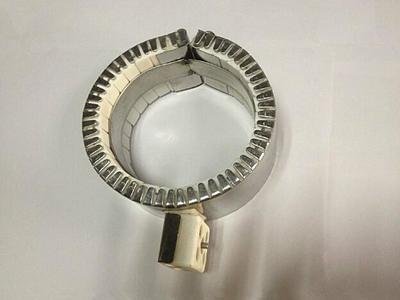
What are the processes of 3D printing ceramic heating rings?
Printing process of ceramic heating rings
Start the 3D printer, transfer the sliced STL model to the 3D printer via data cable, SD card, etc., load the 3D printing material, debug the printing platform, set printing parameters, then the printer starts working. The material will be printed layer by layer, each layer will be bonded together with special glue, and the pattern will be fixed according to the cross-section. The last layer is stacked, just like building a house, bricks are laid layer by layer, but after accumulation, it becomes a three-dimensional house. Finally, after layer-by-layer printing, bonding, and stacking, a complete item will appear before us. The biggest difference between a 3D printer and a traditional printer is that the "ink" it uses is real raw material.
Complete printing, post-processing
Secondly, sometimes the surface of 3D printed objects can be rough (e.g., SLS metal printing), requiring polishing. Polishing methods include physical polishing and chemical ceramic heating ring polishing. Typically, sanding, bead blasting, and vapor smoothing are used.
After the 3D printer finishes, remove the object and perform post-processing. For example, when printing certain overhanging structures, you need to have support structures to hold them up, and then parts can be printed above the overhang. Therefore, this redundant support part needs to be removed for post-processing.
After the 3D printing powder material process is completed, some follow-up treatment measures need to be taken to enhance the molding strength of the ceramic heating ring and extend storage time, including static, forced curing, powder removal, coating, etc. After the printing process, the printed mold must be left for a period of time so that the formed powder and binder can be fully cured through cross-linking reactions and intermolecular forces, especially for powders mainly composed of gypsum or cement.
In addition, except for 3DP printing technology which can achieve color 3D printing, other methods generally can only print single colors. Sometimes it is necessary to color the printed object, such as ABS plastic, photosensitive resin, nylon, metal, etc. Different materials require different pigments.