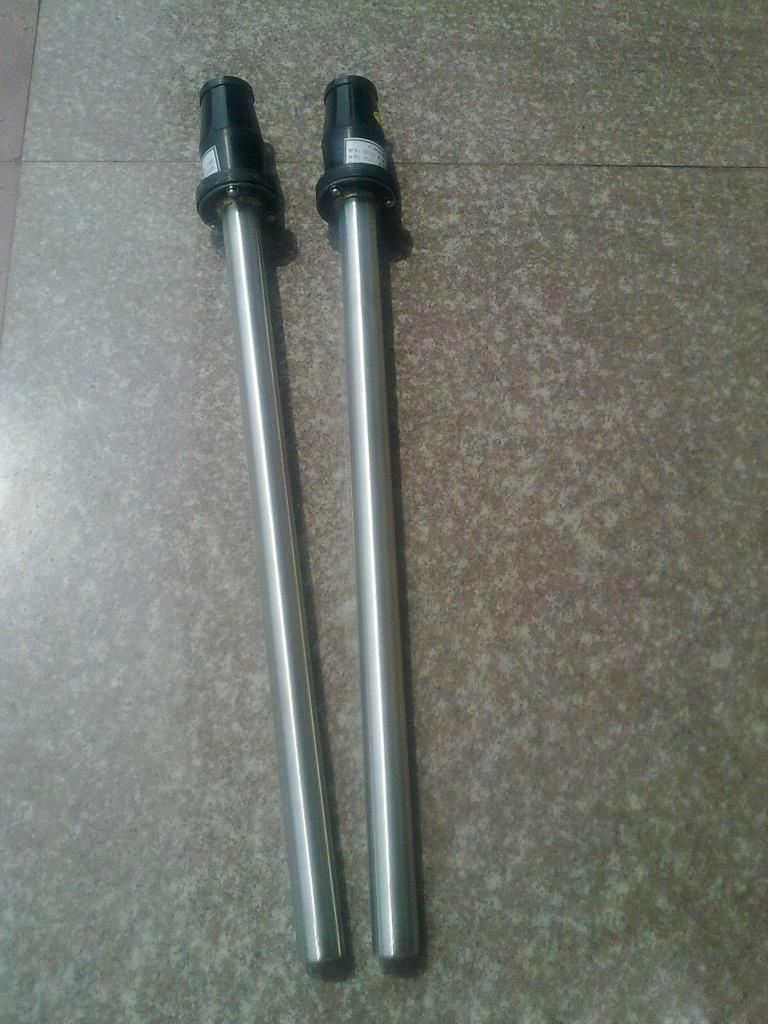
A bolt heating rod is an electric heater suitable for heating bolts during the assembly and disassembly of steam turbine bolts. It can also be used for large bolts of other pressure vessels.
Model Specifications and Parameter Table:

Approved by the Ministry of Machinery and Electronics Industry of the People's Republic of China on 1988-07-20, implemented on 1989-07-01
Note: 1. The heater parameters listed in this table are applicable to bolts with a center hole diameter of d=22.6±0.2mm. For heaters that do not meet the center hole diameter and specification parameters listed in this table, the user and the manufacturer shall agree.
2. The surface power density of the heaters listed in this table is selected as 8-11 W/cm
Technical Requirements:
(1) The steam turbine bolt electric heater shall meet the following requirements:
1. The raw materials used in the electric heater shall meet the following requirements:
① The composition of the insulating material magnesium oxide shall comply with HG3-1294-80 "Magnesium Oxide";
② Magnesium oxide must be dried before use;
③ The heating material used in the electric heater is 0Cr27A17Mo2 high-resistance electric heating alloy wire, with an operating temperature of 400°C, and technical requirements according to GB1234 "High-Resistance Electric Heating Alloy";
④ The protective tube material of the electric heater is 1Cr18Ni9Ti heat-resistant stainless steel tube. Its technical requirements shall comply with YB804 "Stainless and Acid-Resistant Seamless Steel Tubes". Use of other materials shall be agreed between the manufacturer and the user;
⑤ The inside of the protective tube used for the electric heater shall be deburred, then cleaned with gasoline or kerosene, and dried before use.
2. The finished electric heater shall meet the following requirements:
① The rated working voltage of the electric heater is 220±20V. DC 100V, low voltage 50V;
② For heaters with insertion length within 1m, the straightness of the centerline shall not exceed φ0.3mm; for insertion length between 1-2m, the straightness of the centerline shall not exceed φ0.4mm;
③ The diameter deviation of the insertion part is -0.20mm/-0.50mm;
④ The length deviation of the insertion part is ±5mm, the heating length deviation is ±5mm, and the bottom cold end length is 25-30mm;
⑤ The electric heater shall heat evenly during use, and local overheating is not allowed.
(2) During the life test of the electric heater, each heating time is 10-20min. Under intermittent heating conditions, with the total gap between the bolt center hole and the outer diameter of the electric heater being 0.8-1.3mm, the cumulative life shall not be less than 50h.
(3) The connection between the alloy resistance wire and the lead wire shall be firm and reliable, without looseness. The shell must be well grounded.
(4) After the steel tube of the electric heater is cold-drawn and reduced, its surface shall be inspected by dye penetrant testing or with a magnifying glass of 5x or more, and there shall be no cracks or other defects. The tube reduction shall be formed in one direction.
(5) The cold end seal of the electric heater shall be tightly sealed to prevent moisture ingress and insulation damage.
(6) After the electric heater is manufactured, after one and a half months, its insulation resistance shall be measured at room temperature with a 500V megohmmeter (can be performed at the manufacturer or user site) and shall not be less than 50 MΩ.
Test Methods and Acceptance Rules:
After assembly, each electric heater shall have its insulation resistance measured at room temperature with a 500V megohmmeter, which shall not be less than 50 MΩ. It shall also withstand a 1500V dielectric strength test for 1 minute without breakdown or flashover. Then, in air, under the rated working voltage, it shall be energized and heated for 2-3 minutes without overheating, and the insulation resistance shall not be less than 0.5 MΩ, and the leakage current shall not exceed 0.5mA per kilowatt. Its power shall be checked to see if it meets the order requirements (deviation ±5%). After the test, check whether all parts of the electric heater are intact.
Each electric heater shall be inspected and qualified by the manufacturer's quality inspection department, and accompanied by a certificate of conformity.