
Characteristics
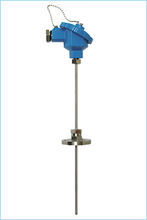
Armored thermocouple is the most widely used temperature device in temperature measurement. Its main characteristics are wide temperature measurement range, relatively stable performance, simple structure, good dynamic response, and the ability to transmit 4-20mA electrical signals over long distances, facilitating automatic control and centralized control. The temperature measurement principle of thermocouple is based on the thermoelectric effect. When two different conductors or semiconductors are connected to form a closed loop, if the temperatures at the two junctions are different, a thermoelectromotive force will be generated in the loop. This phenomenon is called the thermoelectric effect, also known as the Seebeck effect. The temperature difference electromotive force refers to the potential generated at the two ends of the same conductor due to different temperatures. Different conductors have different electron densities, so the potentials they generate are also different. Contact electromotive force, as the name implies, refers to the potential formed when two different conductors come into contact. Due to their different electron densities, electron diffusion occurs, and when they reach a certain balance, the contact potential is formed. The magnitude of the contact potential depends on the material properties of the two different conductors and the temperature at their contact point.
The thermocouples used internationally have a standard specification. The international standard divides thermocouples into eight different graduation types: B, R, S, K, N, E, J, and T. The minimum measurable temperature is as low as minus 270 degrees Celsius, and the maximum can reach 1800 degrees Celsius. Among them, B, R, and S belong to the platinum series therm. Different thermocouples require different compensation wires. Their main function is to connect with the thermocouple, moving the reference end of the thermocouple away from the power source, thereby stabilizing the reference end temperature. Compensation wires are divided into two types: compensating type and extension type. The chemical composition of extension wires is the same as that of the compensated thermocouple, but in practice, extension wires are not made of the same metal as the thermocouple; they are usually replaced by wires with the same electron density as the thermocouple. The connection between the compensation wire and the thermocouple is generally very clear: the positive pole of the thermocouple is connected to the red wire of the compensation wire, while the negative pole is connected to the remaining color. Most compensation wires are made of alloy materials.