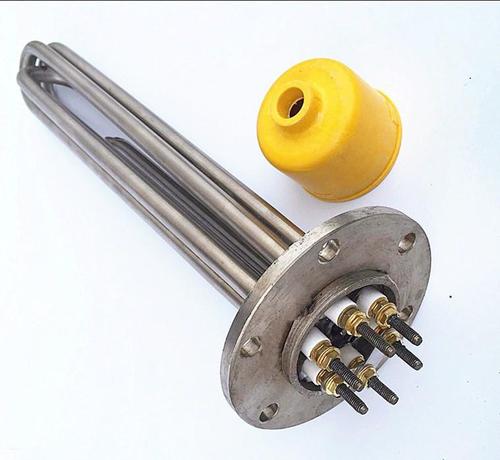

In petrochemical enterprises,explosion-proof electric heating tubes are used to protect the surrounding of the connecting conductors inside the tube, and are equipped with sturdy terminals for connecting to the power supply, thus able to withstand mechanical external forces such as vibration and impact. The production structure must use sealed metal.
Design features of explosion-proof electric heating tubes:
(1) The distance between the heating element and the connecting conductor inside the tube, and between them and the metal protective tube, should be at least 2mm.
(2) The connection between the conductor inside the tube and the heating element is crimped.
(3) The end of the metal tube is fully moisture-proof treated.
(4)Explosion-proof electric heating tubes must also meet the following test conditions in their design principles:
1. Under 1.1 times rated voltage and rated power, power on for 1 minute and power off for 4 minutes as one cycle. After repeating 2000 cycles, apply 1 minute AC voltage, and it should withstand 1600V.
2. After powering the component under 1.1 times rated voltage and rated power for 5 minutes, immerse it completely in water while power is off, with 25 minutes as one cycle. After repeating 50 cycles, place it in the air for 40 minutes, then it should withstand the AC voltage shown earlier for 1 minute.
(5) The explosion-proof structure of explosion-proof electric heating tubes must adopt one of the following explosion-proof structures during manufacturing:
1. Pressure-resistant explosion-proof structure: The metal tubular electric heating element is cast integrally with the sealed shell, and the metal shell has sufficient thickness and strength.
2. Increased safety explosion-proof structure: The sealed electric heating element is installed in a protective shell, part of which adopts stamped steel structure. The mesh must be less than 12mm, but at 100mm from the conductive part, the mesh can be less than 20mm.
(6) Temperature rise limit: The temperature rise limit of parts ofexplosion-proof electric heating tubes that may contact explosive gases (for pressure-resistant explosion-proof structures, it is the temperature rise limit of the shell surface).
Production process of explosion-proof electric heating tubes:
Explosion-proof electric heating tubes are made by welding multiple heating tubes onto a flange for centralized heating. They are mainly used for heating in open or closed solution tanks and circulation systems. They have the following advantages: High surface power, 2 to 4 times the surface load of air heating. Heavy oil explosion-proof flange electric heating tubes are highly dense and compact. Due to their short and dense overall structure, they have good stability and require no support for installation. The combined type mostly uses argon arc welding to connect the heating tube to the flange, or uses a fastening device, where each heating tube is welded with a fastener. Then it is locked with a nut on the flange cover. The tube and fastener are argon arc welded, ensuring no leakage. The sealing part of the fastener adopts scientific technology. Single tube replacement is extremely convenient.