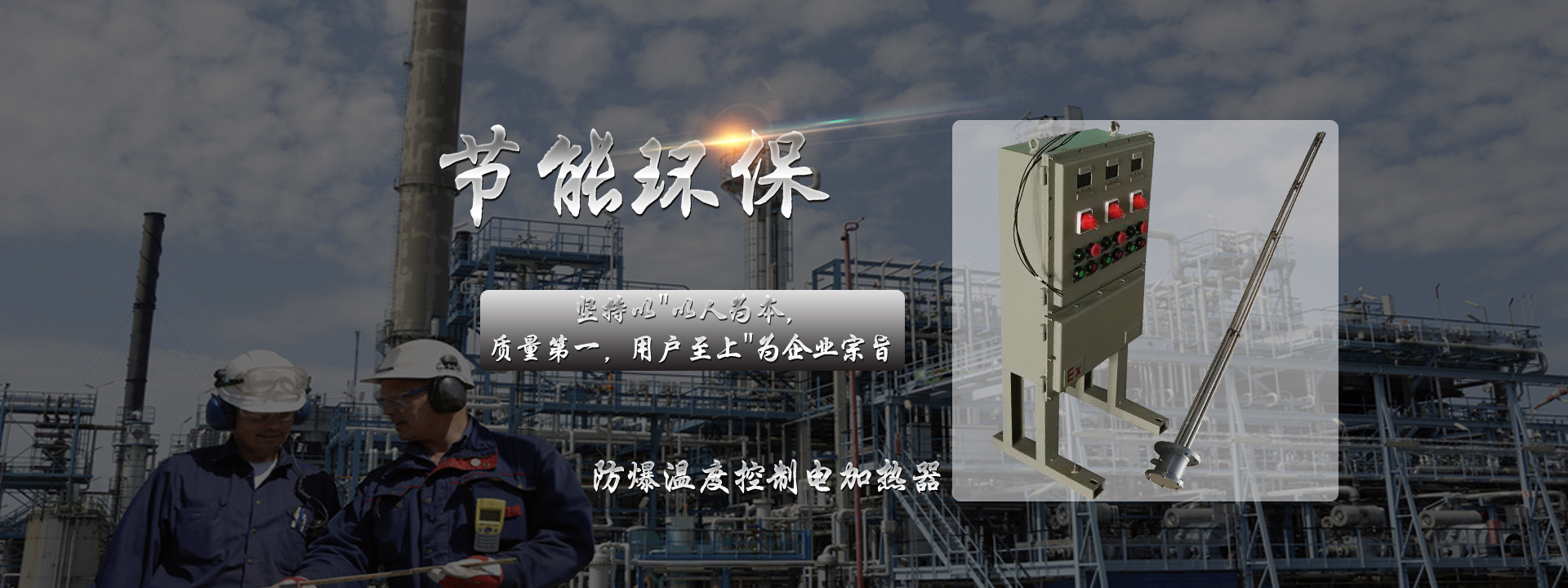
The air heater is an electric heating device mainly used to heat gas flow. The heating element of the air heater is a stainless steel electric heating tube. The inner cavity of the heater is equipped with multiple baffles (guide plates) to guide the gas flow, prolong the residence time of the gas in the cavity, thereby fully heating the gas, making the gas heating uniform, and improving heat exchange efficiency. The heating element of the air heater, the stainless steel heating tube, is made by placing electric heating wires inside a seamless steel tube, filling the gaps with magnesium oxide powder that has good thermal conductivity and insulation, and then shrinking the tube. When current passes through the high-temperature resistance wire, the generated heat diffuses through the crystalline magnesium oxide powder to the surface of the heating tube, and then is transferred to the heated air to achieve the purpose of heating.
The working principle of the air heater is to install a primary coil with more turns and a secondary coil with fewer turns on the same iron core. The ratio of input to output voltage equals the ratio of coil turns, while energy remains constant. Therefore, the secondary coil generates a large current under low voltage conditions. For induction heaters, the bearing is a short-circuited single-turn secondary coil, which passes a large current under low AC voltage, thereby generating a large amount of heat. The heater itself and the magnetic yoke remain at normal temperature. Since this heating method induces current, the bearing will be magnetized. It is important to ensure that the bearing is demagnetized afterward so that it does not attract metal debris during operation. FAG induction heaters have an automatic demagnetization function. It uses the eddy current generated by metal in an alternating magnetic field to heat itself, commonly used in metal heat treatment and other fields. The principle is that when thicker metal is placed in an alternating magnetic field, current is generated due to electromagnetic induction. After the current is generated in thicker metal, it forms a spiral flow path inside the metal, so the heat generated by the current flow is absorbed by the metal itself, causing the metal to heat up quickly. High-temperature resistance wires are evenly distributed inside a high-temperature resistant stainless steel seamless tube, and the gaps are densely filled with crystalline magnesium oxide powder with good thermal conductivity and insulation. This structure is not only advanced and has high thermal efficiency but also heats evenly. When current passes through the high-temperature resistance wire, the generated heat diffuses through the crystalline magnesium oxide powder to the surface of the metal tube, and then is transferred to the heated part or air to achieve the purpose of heating.