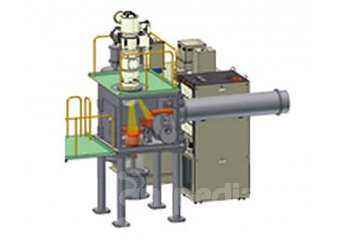
There is an electric heating product called “Electron Beam Furnace” on the market. So what is an “Electron Beam Furnace”?
An electron beam furnace is an electric furnace that uses the heat generated by high-speed electrons bombarding the charge to perform melting. Industrial production of electron beam furnaces began in the early 1960s. Nowadays, electron beam furnaces have been used on a considerable scale for melting refractory metals such as niobium, tantalum, hafnium, tungsten, and molybdenum, and have also developed rapidly in melting high-quality alloy steels.
The basic principle of an electron beam furnace is similar to that of a vacuum electronic diode. It uses tantalum or tungsten, metals that easily emit electrons, as the cathode, while the metal charge to be melted serves as the anode. When the cathode is heated to around 2500°C, thermionic emission occurs on its surface. Under the action of an electric field, the electron beam is directed toward the anode, striking it. The kinetic energy of the electrons is converted into heat energy, melting the anode metal. Therefore, the electron beam furnace is also called an electron bombardment furnace.
Our company is equipped with electron beam furnace systems including:Electron Beam Furnace Closed-Loop Water System andElectron Beam Furnace Warm Water System. Among them,
The 3DElectron Beam Furnace Closed-Loop Water System supplies and recovers cooling water for the electron beam power cabinet. The closed-loop water system includes a water tank, pump, filter, heat exchanger, and various other auxiliary components. The electron beam closed-loop water system provided by 3D Company is a complete mechanical assembly including heat exchangers, field instruments, filters, pump sets, intelligent control valve system, water tank, and other auxiliary components. The closed-loop water system is assembled as a complete skid-mounted component on a base.
Electron Beam Furnace Warm Water System supplies and recovers warm water for the electron beam furnace and its components to prevent moisture condensation in the furnace body under vacuum conditions, which would affect the vacuum pumping speed. The warm water system includes field instruments, a water storage tank, pump sets, filters, heaters, an intelligent temperature control system, an intelligent control valve system, and other auxiliary components. The warm water system is assembled as a complete mechanical skid-mounted component on a base.