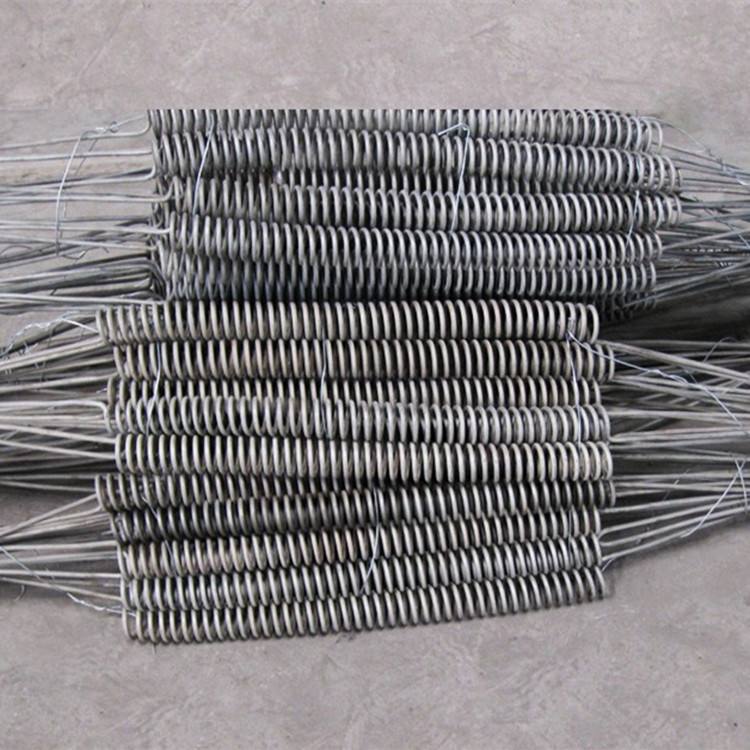

Avoid contact between non-ferrous metals such as copper, aluminum, zinc, tin, and lead with the heating element. Whether in the form of fine powder, molten liquid, or vapor, their erosion at high temperatures is very harmful to the element. This is because the eroded area forms "pits," reducing the cross-section, and eventually causing burnout due to overheating.High-temperature resistance wire in a pit-type carburizing furnace or when using a controlled atmosphere containing CO may cause carbon precipitation leading to short circuits. Therefore, the furnace door should be opened frequently or compressed air should be used periodically for blowing to burn off carbon deposits promptly.
High-temperature resistance wire Before using the electric furnace wire, check the sensitivity of the temperature control system to prevent temperature control failure, which could cause the wire to burn out. The central and edge parts of the heating plate should use heating elements with different power ratings. Generally, the power of the heating element in the center of the mold is slightly lower, while that at the edge is slightly higher.
High-temperature resistance wire resistance and power. Calculate according to Ohm's law: I = V / R and P = I * V. If the resistance wire is too thin (low power), it will burn out. If the wire is very thick but has low resistance, it may burn the wires and blow the fuse. It can work if connected properly. Whether to connect other components mainly depends on the resistance and power of the wire. Capacitors or resistors can be connected in series to reduce voltage, but beware of electric shock because the connection may be to a non-isolated power supply.