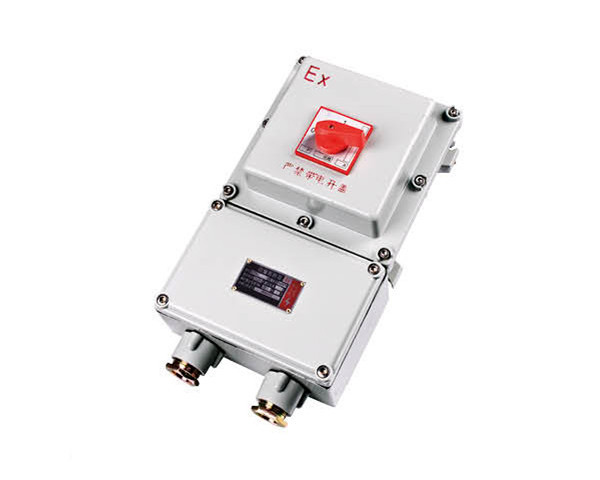

Explosion-proof circuit breaker refers to a device used in hazardous locations where flammable gases and dust exist. It prevents arcs, sparks, and high temperatures that may be generated inside the explosion-proof circuit breaker from igniting the surrounding flammable gases and dust, thereby meeting explosion-proof requirements. Different flammable gas mixture environments have different requirements for the explosion-proof level and type of explosion-proof lights.
Product Features
1. Explosion-proof circuit breaker is made of cast aluminum alloy with surface plastic spraying. The explosion-proof and anti-corrosion circuit breaker is injection-molded from engineering plastic, with an internal explosion-proof circuit breaker.
2. The explosion-proof circuit breaker is equipped with a high-breaking miniature circuit breaker or a low-voltage molded case circuit breaker.
3. The explosion-proof circuit breaker has overload and short-circuit protection functions, and can also be equipped with additional features as required.
4. The explosion-proof circuit breaker includes protection devices such as leakage and shunt release.
5. The explosion-proof circuit breaker can be wired with steel pipes or cables.
6. Indicator lights and buttons can be added as required.
Application Scope Groups
1.1 Classification of hazardous areas with explosive gas atmospheres
Different countries and regions classify explosive hazardous areas according to their own standards. In China, based on the frequency and duration of explosive gas mixtures, explosive gas atmospheres are divided into Zone 0, Zone 1, and Zone 2 (consistent with IEC standards).
Zone 0: An environment where explosive gas mixtures are present continuously or for long periods.
Zone 1: An environment where explosive gas mixtures are likely to occur during normal operation.
Zone 2: An environment where explosive gas mixtures are unlikely to occur during normal operation, or if they do, they exist only for a short time.
Zone 0 generally exists only in sealed containers, storage tanks, and other internal gas spaces. In actual design, Zone 1 is also rare; most cases fall under Zone 2.
1.2 Explosion-proof electrical equipment is divided into two categories:
Class I: Electrical equipment for use in coal mines
Class II: Electrical equipment for use in places other than mines
1.3 Class II electrical equipment is divided into IIA, IIB, and IIC based on the maximum experimental safe gap or minimum igniting current ratio for explosive gas mixtures, and into six groups T1-T6 based on the maximum surface temperature.
1.4 Explosive gas mixtures are grouped by ignition temperature.
1.5 Explosive gas mixtures are classified by the maximum experimental safe gap (MESG) or minimum igniting current ratio (MICR).